EXPERT GUIDE | Lens vs reflector: understanding optics in lighting fixtures
Not all light beams behave the same, even when their beam angles appear identical. In architectural lighting, the optic determines how light transitions into the space. A lens creates sharp, clearly defined beam edges, while a reflector produces softer, more diffuse transitions. This fundamental difference influences visual comfort, atmosphere, and how light is perceived over time.
Understanding optical principles
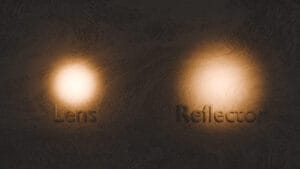
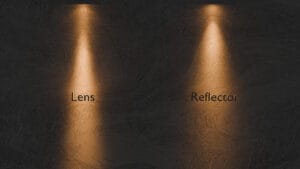
A lens shapes light through refraction. The LED output passes through a transparent material that bends and focuses the beam. This allows precise beam control, narrow spot angles, and clearly visible cut-offs. The beam edge is exact and clearly readable.
A reflector shapes light through reflection. A shaped reflective surface redirects light. Instead of forcing a hard boundary, the reflector allows a gradual transition from light to shadow. This results in softer beam edges and a calmer visual impression.
When reflector optics perform best
Reflector optics are suited to spaces where visual comfort is essential. Softer beam edges reduce glare and minimise harsh contrasts at eye level. This makes reflectors ideal for architectural interiors, hospitality projects, residential environments, and retail spaces where people move, browse, and stay for longer periods.
Reflectors also perform well on vertical surfaces such as walls, shelves, and architectural details. Light appears balanced and natural, without strong hotspots. When switched off, reflector luminaires tend to appear darker and more discreet, supporting clean ceiling design.
When lens optics are the right choice
Lens optics are most effective when precision is required. Narrow beams remain clearly defined over distance, making lenses suitable for accent lighting, feature highlighting, artwork, display cases, or signage. They are also useful at higher mounting heights where focused light placement is needed.
Due to their sharp cut-off, lens optics require careful positioning. In general lighting applications, this level of precision can introduce visual tension if not applied selectively.
Clear comparison at a glance
The table below highlights the practical differences between reflector and lens optics in architectural lighting.
| Aspect | Lens optics | Reflector optics |
|---|---|---|
| Beam edge | Sharp, exact | Soft, diffuse |
| Visual comfort | Moderate | High |
| Precision | High | Medium |
| Glare control | Depends on placement | Very good |
| Appearance | Technical, crisp | Calm, architectural |
| Typical use | Accent and feature lighting | General and retail lighting |
How Karizma Luce applies reflector and lens optics
At Karizma Luce, we work with both reflector and lens optics. The choice is always driven by the application and the desired visual result, not by preference for one system over the other.
For very narrow beam angles, where sharp cut-offs and precise light placement are essential, we apply lens optics. This approach is used in luminaires such as
Gusto,
Juno XS Lente, and
Amata Lente.
These solutions are typically specified for museums, galleries, and object-focused applications, where light needs to isolate artworks or objects with clearly defined beam edges.
For general illumination in architectural, hospitality, and residential environments, Karizma Luce primarily works with reflector optics. Reflectors provide softer beam transitions, better visual comfort, and a calm light distribution that integrates naturally into the space. Depending on the application, reflector optics are combined with different types of glass to fine-tune diffusion, glare control, and visual appearance.
This approach allows precise accent lighting where focus is critical, while maintaining comfortable, balanced illumination in spaces designed for everyday use.
Choosing the right optic
Optical performance is not about choosing the most precise system. It is about selecting the optic that supports the space, the architecture, and the people using it. Reflectors and lenses are both valid solutions when applied with intention and understanding.