48V Track Mini: how it works, what makes it attractive, and the difference between Q3 and Q4
Minimalism in architectural lighting is not only about appearance. It is also about control, integration, and using the right technology for the application. A 48V track system meets this need well. It offers a slim, discreet lighting infrastructure while still allowing professional lighting control and a high level of flexibility.
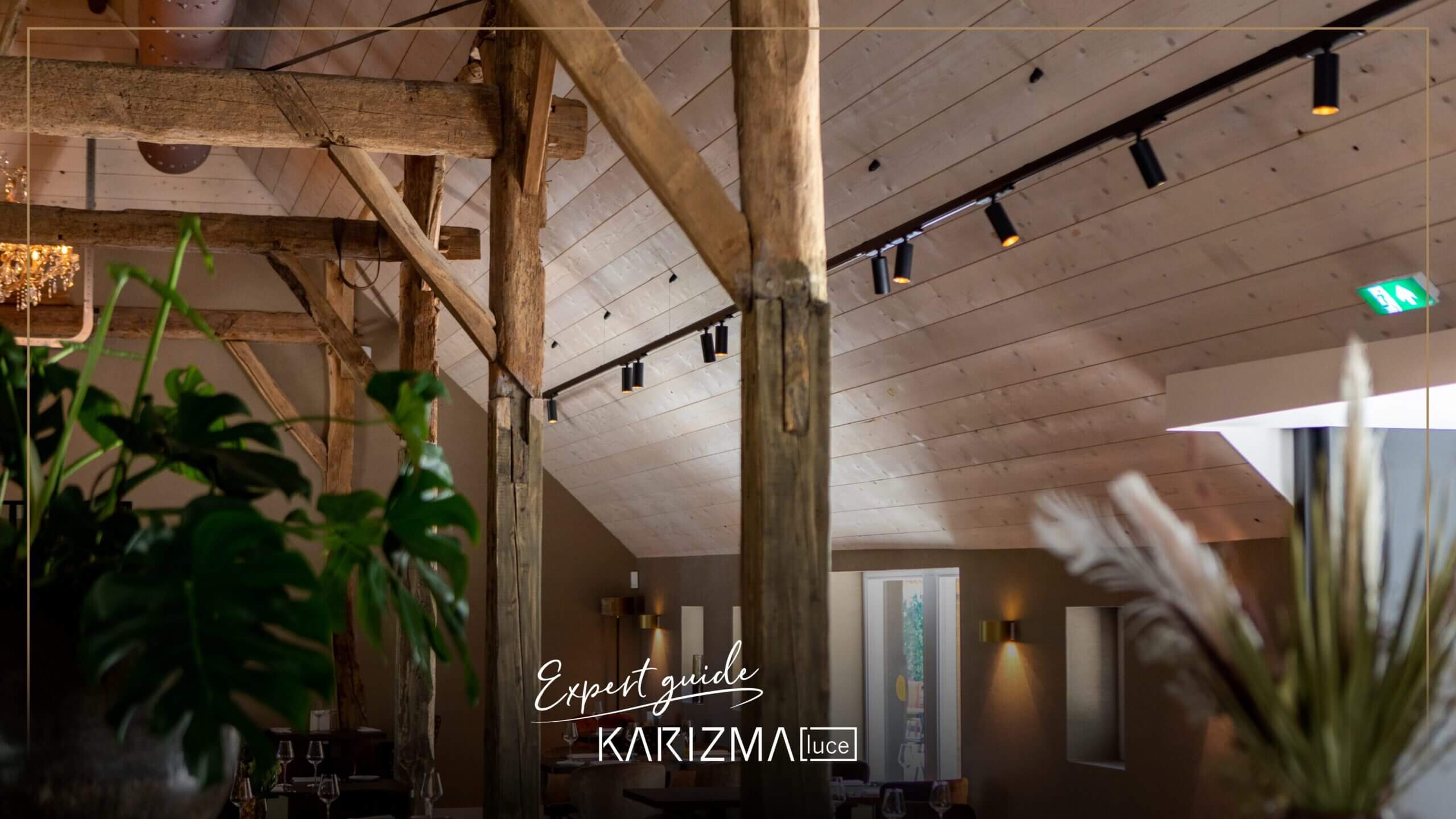
Compared to a traditional 230V track system, a 48V solution works on low voltage. This allows the track profile and the luminaires to become much smaller and more refined. The result is a system that feels quiet within the architecture. It supports clean ceiling lines, subtle integration, and a more elegant visual result. This makes the 48V track especially attractive for residential interiors, hospitality projects, boutiques, galleries, and other spaces where the lighting should support the design without dominating it.
Why choose a 48V track system?
The main advantage of a 48V track system is its minimal scale. The lower voltage allows compact luminaires, slim track profiles, and a more delicate appearance than standard mains-voltage track. This is particularly valuable in interiors where visual calm matters. The system feels technical, but never heavy.
At the same time, the functionality remains familiar. For dimming and lighting scenes, a 48V track system can offer almost the same comfort as a 230V solution. Individual luminaires can still be controlled, grouped, and dimmed professionally. The difference is not in the design freedom, but in the way the system is powered and controlled.
How does a 48V track system work?
A 48V track system cannot be connected directly to the mains supply. It always requires an AC/DC converter, also called a constant voltage driver. This unit converts 230V AC from the mains into 48V DC for the track.
There are two possible ways to do this correctly.
1. Remote AC/DC converter
In this setup, the constant voltage driver is installed remotely, for example, in the ceiling void or another technical space. From there, the 48V DC supply is connected to the track via a feed. This feed can be placed at any position along the track, offering flexibility during installation and layout design.
2. In-track AC/DC converter
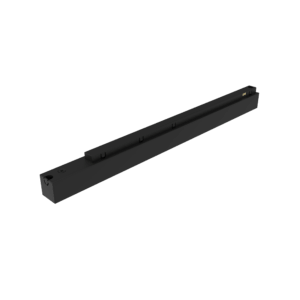
In this version, the AC/DC converter is integrated directly into the track. It works both as a feed and as a constant voltage driver. Because of this, no separate feed is needed. This is a compact and clean solution, but in the Karizma Luce 48V track mini system, it is suitable only for Q3, due to the shallow track construction. The total length of this AC/DC converter is 314mm (the adapter length is 298mm), and it can be inserted at any point on the track to feed the track. Please check the dimensional drawings in the datasheet: KGP LV100W48VDC-M-A
Dimming and control: what is possible and what is not?
This is one of the most important things to understand in a 48V track system.
The constant voltage driver is not a control unit. Its task is only to convert 230V AC to 48V DC. It powers the track, but it does not control the luminaires. Therefore, it does not need to be DALI-addressable.
The actual dimming and control function is located inside the luminaire, in the DC/DC driver. This internal driver allows each luminaire to be controlled individually.
For Karizma Luce 48V track mini luminaires, dimming and control are available through:
- DALI
- Casambi
Phase cut dimming, including triac dimming, is not possible in this system. A 48V track mini system is therefore not controlled like a standard mains-voltage luminaire with a phase-cut wall dimmer. The control intelligence is built into the luminaire itself, not in the constant-voltage power supply.
What makes our 48V track mini attractive?
What makes the Karizma Luce 48V track mini system attractive is the balance between scale, precision, and architectural freedom. It offers the visual lightness many projects require today, without losing control. The system is discreet, low voltage, and technically clean. It gives designers the opportunity to work with track lighting in a much more refined way.
It is especially suitable for projects where compact size matters. Residential interiors, hotel rooms, hospitality concepts, showrooms, and boutique spaces often benefit from a lighting solution that feels calm and integrated. A 48V mini system supports this atmosphere very naturally.
At the same time, expectations should remain realistic. A 48V mini system is not meant to replace every type of 230V track installation. Due to the luminaires’ compact size, the focus is on elegance, accent lighting, and controlled illumination. It is not the system for applications that require very high-lumen packages or larger fixture proportions.
Connection principles and power planning
Proper functionality of a 48V track system depends not only on the right components, but also on correct electrical planning. The AC/DC converter must be selected carefully, taking both distance and total connected load into account.
The recommended maximum distance between the last luminaire on the track and the AC/DC converter is 15m. This helps to maintain reliable system performance and limits unwanted voltage drop.
In addition, the AC/DC converter should be loaded to around 90% of its nominal power, not to the full theoretical maximum. For example, if one luminaire has a system power of 10W and the AC/DC converter is rated at 100W, the practical recommendation is to connect a maximum of 9 luminaires, not 10.
If a longer track run or a higher connected load is required, the track must be divided correctly. In such cases, the conductors need to be disconnected to create a separate electrical section and avoid short-circuit risk or unwanted interaction between power supplies. A second AC/DC converter can then be added to this new section.
This is an important design principle in larger 48V track layouts. The system may look minimal, but the electrical segmentation must still be handled with precision.
Q3 and Q4: What is the difference?
Within the Karizma Luce 48V track mini range, the difference between Q3 and Q4 is mainly mechanical, but it has direct consequences for installation and luminaire selection.
Q3
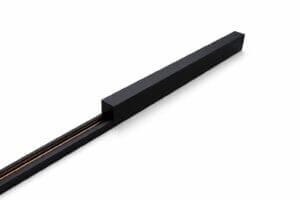
Q3 is a shallow track profile designed for surface-mounted applications. It is compact, clean, and highly discreet. Because of its limited depth, it is also the version compatible with the in-track AC/DC converter.
Q4
Q4 is a deeper track profile. It offers greater versatility for installation and can be used for surface-mounted, recessed, or suspended applications. Because the conductors sit deeper inside the profile, luminaires for Q4 require a longer stem to connect correctly.
This means the luminaire must always be selected to match the chosen track. A luminaire designed for Q3 is not simply interchangeable with Q4, and vice versa. Proper matching between the track and the luminaire is essential for proper functionality.
Special track configurations on request
For projects that require a more custom approach, the 48V track mini system can also be adapted into special shapes and constructions. On request, we can provide:
- bended tracks
- up/down suspended versions
- tubular suspended shapes2
These options make the system even more flexible for architectural concepts in which the track itself becomes part of the project’s visual language.
Conclusion
A 48V track mini system offers a very refined answer to contemporary architectural lighting. It is minimalistic, low voltage, discreet, and technically precise. It brings the visual calm many interiors need, while still allowing individual luminaire control through DALI or Casambi.
The key is to understand the system’s structure correctly. The constant-voltage driver powers the track but does not dim it. Phase-cut or TRIAC dimming is not suitable. Proper functionality depends on the right AC/DC conversion, the correct feed solution, the right power calculation, and the correct combination of track type and luminaire.
When these elements are aligned, the 48V track mini becomes a very elegant tool for residential and hospitality lighting. Small in scale, but highly effective in application.
Download the 48V explanation brochure.