EXPERT GUIDE: reducing glare in architectural lighting
Glare is one of the most important topics in architectural lighting because it directly affects visual comfort and the way people experience a space.
In simple terms, glare occurs when a light source appears excessively bright compared to its surroundings. The human eye then struggles to adapt comfortably to the contrast. This can create discomfort, visual fatigue, reduced concentration or even reduced visibility.
Glare is not only about brightness. A luminaire can have relatively low power and still feel uncomfortable if the light source is visible, poorly shielded or positioned incorrectly.
There are generally two main types of glare:
- Discomfort glare — light that feels visually disturbing or tiring
- Disability glare — light that actually reduces the ability to see clearly
In architectural lighting, discomfort glare is usually the primary concern.
Glare perception depends on multiple factors working together:
- brightness of the light source
- size of the luminous surface
- viewing angle
- contrast with surrounding surfaces
- beam intensity
- luminaire position
- observer movement
Because of this, glare control is never solved by one specification alone. In this guide, we will look at the main methods used to control glare and improve visual comfort.
1. The construction of the luminaire itself
The first and most important glare reduction tool is the luminaire itself. The optical design of the fixture strongly influences how comfortable the light feels.
Deep light source
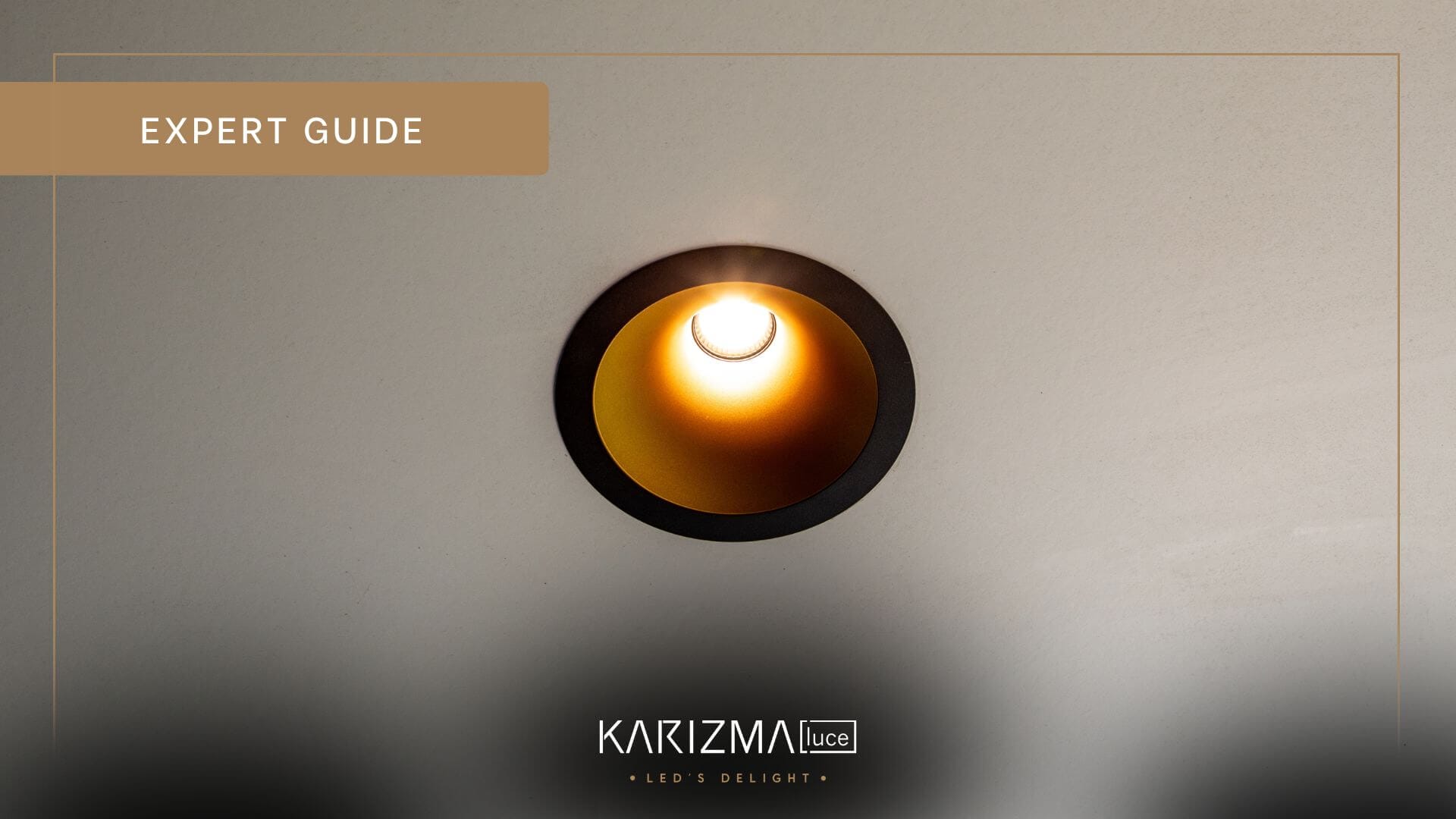
A deeply recessed LED immediately improves visual comfort because the observer cannot directly see the brightest part of the source.
The deeper the source sits within the luminaire, the lower the perceived direct glare.
Colour of the luminaire interior
Black internal reflectors absorb more light and reduce internal reflections. The result is lower brightness perception and improved visual comfort.
White or specular reflectors are usually more efficient because they reflect more light outward, but they may also appear visually brighter and more aggressive.
This demonstrates one of the key compromises in lighting design: maximum efficiency does not always create maximum comfort.
Beam angle
Beam angle strongly influences glare perception.
Narrow beams concentrate the luminous flux into a smaller area. If the observer remains outside this area, glare perception is usually reduced. Therefore, a narrower beam angle can often improve visual comfort with the same luminaire.
At the same time, narrow beams also create higher intensity inside the beam itself, which must still be considered carefully.
Luminous flux
Higher lumen output naturally increases the potential for glare. Higher luminous flux with otherwise identical parameters will usually create stronger visual intensity and higher brightness perception.
2. Accessories for glare reduction
Additional optical accessories can further reduce glare or modify the beam’s visual behaviour. These accessories usually work by shielding the source, softening the beam or reducing contrast.
Anti-glare rings
Anti-glare rings are one of the most common glare-control elements in Karizma Luce luminaires. In many products, the ring is positioned closely around the light source and remains visible as a subtle internal detail.
The ring helps shield the brightest part of the optic from direct viewing angles. It also creates a darker visual transition around the light source, which reduces brightness perception and gives the luminaire a calmer appearance.
Anti-glare rings are especially effective in compact architectural luminaires, where the LED source is small but visually intense.
Snoots
Snoots extend the optical cut-off of the luminaire. They create additional shielding depth around the optic, reducing side glare and limiting direct visibility into the light source from wider viewing angles.
A good example is the snoot accessory for Caro. It improves visual comfort in accent lighting applications where the luminaire may be visible from multiple directions.
Honeycomb
Honeycomb filters reduce glare by blocking direct viewing angles into the optic. They create a darker appearance and make the luminaire feel visually calmer.
Honeycomb accessories are used in products such as Caro and Tesoro, where additional shielding can be beneficial for hospitality projects, galleries, residential interiors or accent lighting applications.
The main compromise is efficiency. A honeycomb reduces the luminous flux and may slightly influence the beam shape.
Scattering filters
Scattering filters soften the beam and reduce contrast inside the light distribution. By reducing sharp intensity differences, they often create a calmer and more comfortable visual impression.
Compared to honeycomb filters, scattering filters create smoother transitions and softer beam edges. However, beam precision becomes lower and intensity is reduced.
Microprismatic diffusers
Microprismatic optics redistribute the light through microscopic optical structures. They help break up direct brightness and distribute the light more evenly across the emitting surface.
The result is a softer visual appearance with improved comfort during longer viewing exposure. The compromise is reduced beam sharpness and slightly lower optical efficiency.
Snoot with honeycomb
For stronger glare control, a snoot and honeycomb can also be combined. This creates two levels of shielding: the snoot increases the physical cut-off, while the honeycomb further blocks direct visibility into the optic.
This combination can be highly effective in projects where visual comfort is more important than maximum output. However, it also has a clear technical consequence. When a snoot and honeycomb are used together, the luminous flux can be reduced by approximately 40%.
Because of this, the combination should be selected carefully. In some situations, it is the ideal solution. In others, a lower lumen package, different beam angle or improved luminaire positioning may achieve the required comfort with less loss of efficiency.
Barndoors
Barndoors mainly control spill light and beam direction. They are not directly designed for glare reduction, but by limiting unwanted light directions they can indirectly improve visual comfort inside the space.
Reducing uncontrolled spill light often helps lower unnecessary brightness contrasts.
3. Positioning of the luminaire
Even the best low-glare luminaire can become uncomfortable if positioned incorrectly. Positioning is often just as important as the luminaire specification itself.
Orientation toward the observer
A deeply recessed spotlight with excellent optics may still create discomfort if aimed directly toward the observer.
Orientation and viewing angle often influence glare more strongly than the specification itself.
Mounting position
Ceiling height, distance from walls and observer movement all influence visual comfort.
A luminaire that feels comfortable in one position may become visually aggressive in another.
Glare is dynamic. It changes depending on where the observer stands and where they look.
Why UGR is not everything
UGR, or Unified Glare Rating, is commonly used to evaluate glare, but it does not fully describe real visual comfort in every situation.
UGR calculations are most reliable for fixed and uniform lighting layouts. Directional luminaires behave differently because glare depends strongly on:
- aiming direction
- mounting position
- observer movement
- viewing angles
A luminaire with an excellent UGR value can still create discomfort if aimed incorrectly.
This is why real-world glare evaluation always requires visual judgement in addition to technical data.
Summary of glare reduction methods
| Category | Method | Advantages | Disadvantages |
|---|---|---|---|
| Luminaire construction | Deep light source | Lower direct glare, calmer appearance, improved visual comfort | Lower optical efficiency, larger luminaire depth |
| Luminaire construction | Black interior | Reduced reflections, darker optics, visually softer appearance | Lower efficiency compared to specular reflectors |
| Luminaire construction | Narrow beam angle | Lower glare outside beam area, higher precision | Higher intensity inside the beam, stronger contrast |
| Luminaire construction | Lower luminous flux | Improved comfort, softer perception | Lower illuminance levels |
| Accessories | Anti-glare ring | Darker appearance, improved shielding, calmer optics | Slight reduction of efficiency |
| Accessories | Honeycomb | Reduced direct glare, darker appearance, improved shielding | Lower lumen output, lower efficiency, possible beam disturbance |
| Accessories | Scattering filter | Softer beam, smoother transitions, reduced contrast | Reduced beam precision, lower intensity |
| Accessories | Microprismatic diffuser | Reduced glare perception, softer appearance, improved comfort | Lower efficiency, less beam sharpness |
| Accessories | Snoot | Better shielding, reduced side glare, improved cut-off | Larger visual appearance, reduced beam openness |
| Accessories | Snoot + honeycomb | Very strong glare reduction, maximum shielding | Up to 40% lower luminous flux, reduced efficiency |
| Accessories | Barndoors | Better spill-light control, reduced unwanted brightness | Less clean beam shape, larger accessory size |
| Positioning | Correct orientation and positioning | Major improvement of visual comfort without additional accessories | Requires careful planning and aiming |
Balance is the real solution
Good glare control is never achieved through one component alone.
The best visual comfort is usually created through a combination of:
- deep optics
- controlled lumen output
- suitable beam angle
- optical accessories
- correct positioning
Every glare reduction method involves some compromise between comfort, efficiency, beam precision and visual appearance.
The goal is not to eliminate brightness completely, but to create light that feels natural, controlled and comfortable for the human eye.
The best architectural lighting installations are often the ones people barely notice visually, because the light simply feels comfortable inside the space.