EXPERT GUIDE | What IP ratings in lighting really mean
How to choose the right protection for wet and outdoor environments
When designing lighting, the focus often falls on beam angles, colour temperature, or visual integration. However, none of these parameters matters if the luminaire cannot withstand its environment.
This is where IP ratings become essential.
IP classification defines how well a luminaire resists dust and water. It directly determines where a product can be used, how long it will perform, and how much maintenance it will require. In outdoor or humid environments, this is not a secondary specification. It is a design decision.
What IP ratings really mean
IP stands for Ingress Protection. It is an international standard that classifies the level of protection a luminaire offers against external elements.
As shown in the guide, IP ratings consist of two digits :
- The first digit indicates protection against solid particles such as dust (scale 0–6)
- The second digit indicates protection against water (scale 0–9)
For example:
- IP65 means the luminaire is fully dust-tight and protected against water jets
- IP67 means it is dust-tight and protected against temporary immersion in water
These differences are not theoretical. They define whether a luminaire will continue to perform in real conditions.
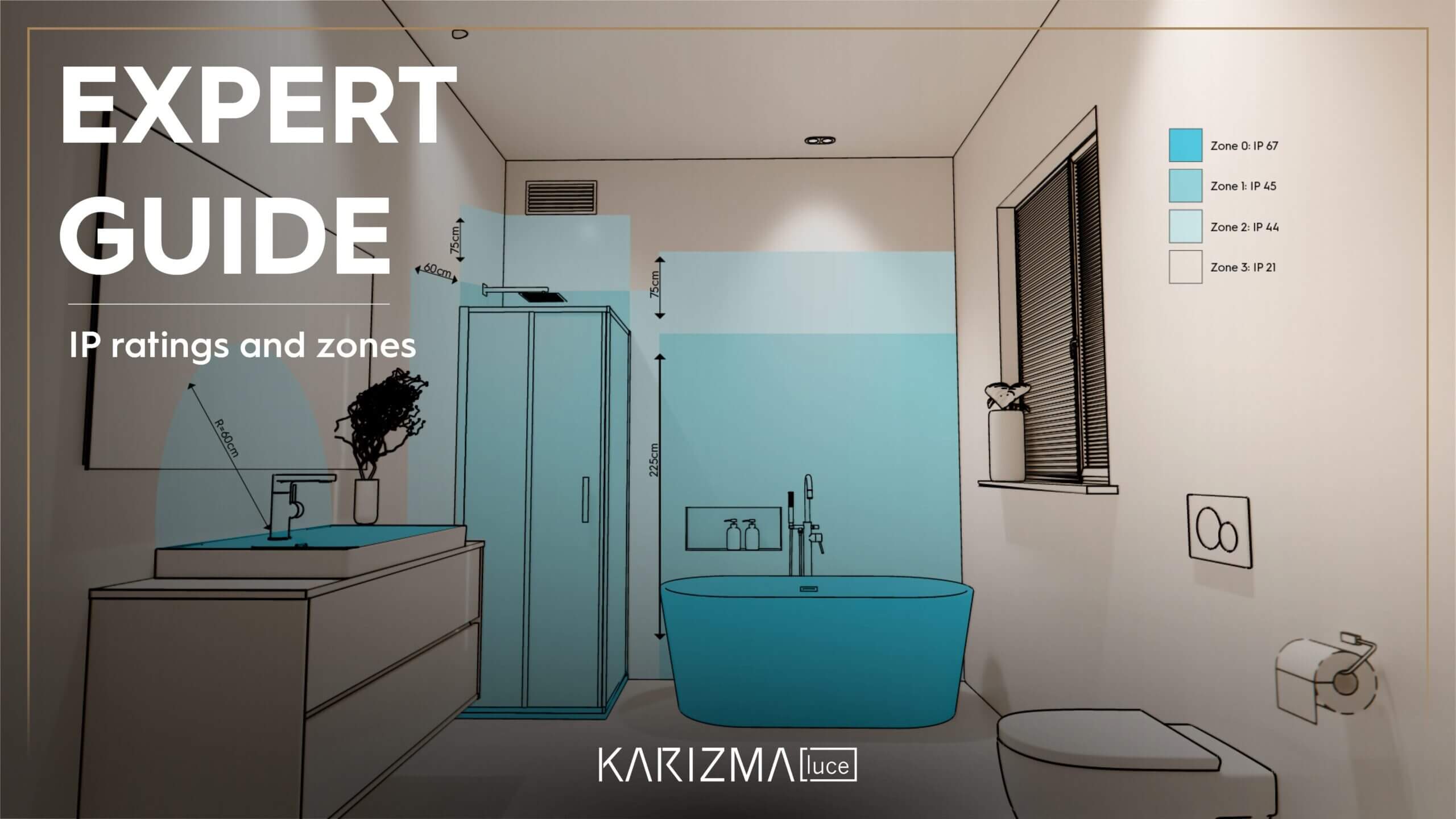
Understanding bathroom IP zones
In wet environments such as bathrooms, IP requirements are not uniform. The space is divided into zones based on water exposure.
As illustrated in the guide :
- Zone 0
Inside the bath or shower area
Requires IP67 - Zone 1
Directly above the bath or inside the shower zone
Requires IP45 - Zone 2
Up to 60cm around the bath, shower or sink
Requires IP44 - Zone 3
Outside the defined wet zones
Requires IP21
These zones are not only about compliance. They help define where and how lighting can be integrated safely.
Applying IP ratings in real projects
In practice, selecting the right IP rating depends on exposure conditions.
For areas where water may hit the luminaire but does not remain, such as façades, canopies or bathroom ceilings, IP65 is typically sufficient. It protects against dust and splashing water while maintaining design flexibility.
In contrast, areas where water can collect or where the luminaire may be submerged require a higher level of protection. IP67 is suited for in-ground applications, recessed outdoor positions or locations where standing water is possible.
Using a lower rating in these conditions can lead to failure over time. Moisture ingress can affect both performance and safety, often resulting in early replacement.
IP rating as part of the lighting concept
IP classification should not be treated as a final check. It should be part of the design process from the beginning.
By selecting the correct protection level, you define:
- The durability of the installation
- The maintenance cycle
- The long-term reliability of the lighting system
At the same time, it allows consistency across different zones. Indoor, transitional and outdoor spaces can maintain the same visual language, while each luminaire performs according to its environment.
Conclusion: performance beyond appearance
Lighting design is not only about how light looks, but how it performs over time.
The right IP rating ensures that a luminaire continues to function in rain, humidity or direct water exposure. It protects the investment, reduces maintenance, and supports a stable lighting experience.
A well-designed lighting plan considers both optics and protection.
Because lighting should not only look right, it should last.